

India’s e-waste problem is growing faster than most people realise. According to the Central Pollution Control Board, the country generated over 14.14 lakh metric tonnes of e-waste in 2025-26 alone, up from 13.97 lakh tonnes the year before. That’s old phones, laptops, circuit boards, batteries, and every kind of electronic device you can imagine, piling up faster than we can safely process it.
If you’re in the recycling business, running a scrap yard, or setting up an e-waste dismantling unit, the machine at the centre of all of this is your shredder. Buy the right one, and you’ll process material efficiently, meet compliance norms, and actually make money. Buy the wrong one, and you’ll be stuck with breakdowns, poor output quality, and rising maintenance bills.
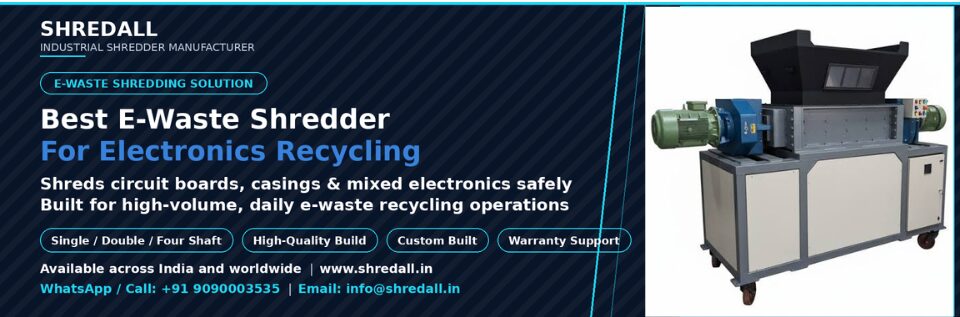
At Shredall, we’ve spent years building shredding machines for India’s recycling industry, and this guide walks you through everything we tell our own customers when they’re choosing an E-waste Shredder, so you can make a decision you won’t regret.
Contact Us Now to get the right shredder machine details
Contact Details: Call / WhatsApp: +91 9090003535 and Email: Info@shredall.in
E-waste isn’t like plastic or paper waste. It contains a mix of metals, plastics, glass, and hazardous elements like lead, mercury, and cadmium, all bundled into one device. Shredding is usually the first and most important step in separating these materials so they can be recycled safely and profitably.
Why E-Waste Shredding Is Becoming a Serious Business in India
A few things are driving demand for e-waste shredders right now:
- The E-Waste (Management) Rules, 2022 have tightened Extended Producer Responsibility (EPR) norms, pushing manufacturers and recyclers to formalise their processing.
- Recycling volumes are climbing every year. India recycled nearly 9.79 lakh tonnes of e-waste in 2025-26, a big jump from 7.78 lakh tonnes just two years earlier.
- Urban consumption of electronics keeps rising, which means the raw material for shredding businesses isn’t slowing down anytime soon.
In short, if you’re getting into e-waste recycling now, you’re entering a market that’s only going to expand.
What Makes a Shredder Suitable for E-Waste (Not Just Any Shredder)
Not every industrial shredder is built to handle electronics. E-waste is unpredictable, one batch might be soft plastic keyboards, the next might be dense server racks packed with metal and circuit boards. A shredder designed for e-waste needs a few specific qualities:
1. Cutting strength that handles mixed hardness Electronics combine soft plastics, tough metal casings, and dense circuit boards in the same load. The shredder’s blades and torque need to handle all of it without jamming or wearing out quickly.
2. Built-in safety for hazardous components Batteries, capacitors, and certain circuit boards can be hazardous if crushed carelessly. A good e-waste shredder is designed to reduce fire risk and control dust and fume release during shredding.
3. Consistent output size Downstream recycling processes (like magnetic separation or eddy current separation) need uniformly shredded material to work efficiently. Inconsistent shred size slows down your whole recycling line.
4. Low maintenance and long blade life E-waste is abrasive. Shredders built with lower-grade steel wear out fast, leading to frequent blade replacements and costly downtime.
Types of Shredders Used for E-Waste
Different e-waste streams need different cutting mechanisms, which is why we manufacture a full range at Shredall rather than a single one-size-fits-all machine. Here’s a quick breakdown:
Single Shaft Shredders
Best suited for lighter, more uniform e-waste like plastic casings, cables, or smaller appliance parts. Our Single Shaft machines give a clean, consistent particle size and are a good entry point for smaller recycling operations.
Double Shaft Shredders
Ideal for tougher, mixed e-waste, things like computer towers, monitors, printers, and small home appliances. The two counter-rotating shafts tear through mixed-density material more effectively than a single shaft can, which is why this is the configuration we recommend most often for general e-waste processing.
Four Shaft Shredders
Used where a fine, uniform output is required in a single pass — useful for operations that need to feed shredded material directly into sorting or separation equipment without a secondary shredding stage.
Customised Shredders
Large-scale recyclers dealing with server racks, transformers, or bulk industrial electronics often need shredders built around their exact throughput and material requirements. A standard off-the-shelf machine isn’t always enough here, so we design and build customised shredders around what our customers actually process, not the other way around.
What to Check Before You Buy an E-Waste Shredder in India
If you’re comparing suppliers, here’s a practical checklist:
- Build quality of blades and shaft — Ask what grade of steel is used and how often blades need replacement under regular use.
- Motor power vs. your daily throughput — A shredder that’s underpowered for your volume will overheat and break down faster.
- After-sales support and spare parts availability — This matters more than most buyers realise. Imported machines often mean longer wait times and higher costs for spare parts and service visits.
- Warranty terms — Understand exactly what’s covered, and for how long.
- Customisation options — If your waste stream is unusual (like bulk transformers or server equipment), check whether the manufacturer can modify the machine for you.
- Compliance support — A good manufacturer should understand India’s E-Waste Management Rules and help you set up a compliant processing line, not just sell you a machine.
Why We Believe Indian-Made Shredders Often Make More Sense
A lot of recyclers assume imported machines are automatically better. In our experience building and supporting shredders for the Indian market, that’s not always true:
- Local spare parts availability means far less downtime when something needs replacing. As an Indian manufacturer, we keep this simple for our customers.
- Machines built for Indian conditions (heat, humidity, variable power supply) tend to hold up better over time than equipment designed for cooler climates. We build every Shredall machine with these conditions in mind from the start.
- Faster on-ground service response, since our technicians are a phone call away instead of a flight away.
- Lower total cost of ownership once you factor in shipping, import duties, and the cost of getting an overseas engineer out for repairs.
Choosing the Right Shredder for Your Business Size
- Small recycling units processing household electronics and smaller devices generally do well with a single shaft shredder.
- Mid-to-large scale recyclers handling a mixed stream of computers, appliances, and general e-waste usually need a double shaft shredder for reliable, high-volume processing.
- Large industrial operations dealing with bulk electronics, server equipment, or specialised waste streams often need a four shaft or fully customised shredder built around their specific process.
Final Thoughts
E-waste recycling in India is only going to grow from here, and the shredder you choose will directly decide how efficiently, safely, and profitably you can run your operation. Look past the price tag and focus on build quality, after-sales support, and whether the machine is genuinely designed to handle the mixed, unpredictable nature of electronic waste.
That’s exactly the standard we hold ourselves to at SHREDALL. As a manufacturer of Single Shaft, double shaft, and Four Shaft e-waste shredders, we build every machine using high-quality materials designed to handle India’s demanding recycling conditions. We also manufacture customised shredders based on specific buyer requirements, and we supply across India and worldwide, backed by warranty coverage and dedicated after-sales support.
If you’re setting up or scaling an e-waste recycling operation, get in touch with our team at Shredall to find the right shredder configuration for your needs.